Cat Had Uti and Meds but Now Acting Like Trouble Peeing Again
My true cat of a sudden began going to the litterbox very ofttimes. A sample of urine revealed a bladder infection. How did this happen? 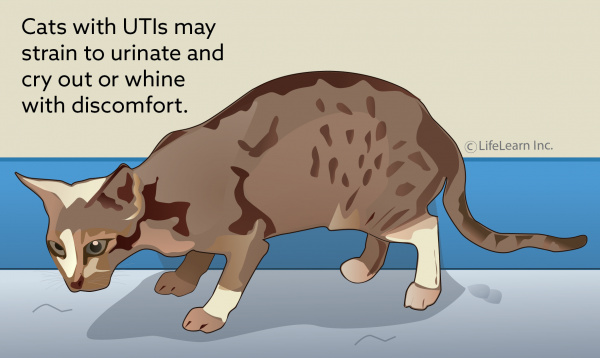
While urinary tract disorders are fairly mutual in cats, urinary tract infections (UTIs) are fairly uncommon. Cats with UTIs try to urinate very frequently, they may pass only small amounts of urine, they may strain to urinate, they may cry out or whine when urinating, and there may be claret visible in their urine. Urinating exterior of the litterbox is also a red flag that something is incorrect in the float. Finally, frequent licking around the rear terminate may signal that a UTI is nowadays.
Generally, a UTI occurs when bacteria travel upward the urethra and into the bladder. Urine in the float is supposed to be sterile, but once bacteria discover their way to the bladder, the bacteria tin can abound and reproduce, causing the UTI. Some cats will develop bladder stones, with or without a UTI, and this opens the door for additional health issues.
What does a urinalysis look at?
If your cat presents to your veterinary with urinary signs, your veterinarian will first perform a urinalysis. The urinalysis tin reveal so much important information about the urine when a UTI is suspected. Your veterinarian will look for the following:
- urine-specific gravity (how well the cat is concentrating their urine)
- pH (certain pH levels tin can indicate infection or other problems)
- ketones (sometimes seen in cases of diabetes or body-wasting)
- glucose (sugar in the urine, unremarkably a sign of diabetes)
- bilirubin (a breakdown product of blood)
- claret
- protein
Once these levels are measured, the urine specimen is placed into a centrifuge and spun downwards to let cells and other debris to accumulate at the bottom of the sample tube. That debris can then exist evaluated, revealing the presence of red claret cells, white blood cells, bacteria, and crystals.
My veterinarian sent a sample of urine to a laboratory for what she called a culture and sensitivity test. What is this?
All urinary tract infections are Non created equal! Even though the most mutual organism to cause UTIs in cats is Escherichia coli (the leaner plant in carrion), there are several other organisms that may be involved. The only fashion to identify which specific leaner is causing the UTI, is to abound it in a laboratory. At the same time, the laboratory can too test which antibiotic is best suited to treat the infection.
"The only fashion to identify which specific leaner is causing the UTI, is to abound it in a laboratory."
Often, a veterinarian will prescribe an antibody that is amongst the nigh commonly used for treating UTIs in club to effort to provide immediate relief to the cat. They may also prescribe hurting medications (UTIs tin be uncomfortable), and may recommend a nutrition modify.
In one case the culture and sensitivity results are received, an appropriate antibiotic volition be prescribed. After the form of antibiotics is given, it is important to recheck the urinalysis to ostend that the infection is resolved. If information technology is non, then it volition exist important to look for other problems that may contribute to a persistent UTI.
Are some cats predisposed to UTIs?
Older female cats, and cats with diabetes mellitus (carbohydrate diabetes), develop UTIs more usually than the full general population. Cats who have bladder stones are prone to recurrent UTIs, pointing out the importance of getting a complete diagnosis whenever there are signs of disease in the urinary tract. Bladder stones must be removed or dissolved in order to restore float health (see handout "Bladder Stones in Cats" for further information).
What can I do to prevent a UTI from occurring in the future?
Your veterinary will let yous know if at that place is anything that tin can be done to prevent your true cat's UTI from coming back. There is show that specific diets can back up lower urinary tract wellness. Information technology is best to discuss UTI prevention and bladder health with your veterinarian in social club to put into action an effective plan.
Source: https://vcahospitals.com/know-your-pet/urinary-tract-infections-utis-in-cats
0 Response to "Cat Had Uti and Meds but Now Acting Like Trouble Peeing Again"
Post a Comment