The Indian Art a Vimana Is a Cylindtical Towrr
Dravida Mode of Architecture is 1 of the types of Temple architecture. It is an of import segment of the Art & Culture syllabus of the IAS Exam. This article will provide you with the Dravida Style of Architecture that originated during the reign of Mahendravarman-I of Pallava Dynasty.
Temple Architecture in Bharat-Function Three (UPSC Notes):- Download PDF Here
Dravidian Style of Compages – South Indian Way
The features of the Dravidian Mode of Architecture are mentioned below:
-

- The temple is enclosed within a chemical compound wall.
- Gopuram: The entrance gateway in the center of the front end wall.
- Vimana: The shape of the main temple belfry. It is a stepped pyramid that rises upwardly geometrically (unlike the Nagara manner Shikhara that is curving).
- In the Dravida style, shikhara is the word used for the crowning chemical element at the pinnacle of the temple (which is shaped like a stupika or octagonal cupola).
- At the entrance to the garbhagriha, there would exist sculptures of violent dvarapalas guarding the temple.
- Generally, at that place is a temple tank inside the chemical compound.
- Subsidiary shrines could be establish wither within the main belfry or beside the chief tower.
- In many temples, the garbhagriha is located in the smallest tower. It is too the oldest. With the passage of time and the rising of the population of the temple-town, boosted boundary walls were added. The newest structure would by and large have the tallest gopuram.
- Example in the Sriranganathar Temple at Srirangam, Tiruchirappally, in that location are seven concentric rectangular enclosure walls each having gopurams. The tower at the centre has the garbhagriha.
- Famous temple towns of Tamil Nadu: Kanchipuram, Thanjavur (Tanjore), Madurai and Kumbakonam.
- In the 8th to 12th centuries – temples were not bars to being religious centres just became administrative centres likewise with big swathes of land.
Dravidian Compages – Subdivisions of Dravida Manner
- Kuta or Caturasra: square-shaped
- Shala or Ayatasra: rectangular-shaped
- Gaja-prishta or vrittayata or elephant-backed: elliptical
- Vritta: circular
- Ashtasra: octagonal
Pallava Compages
- The Pallava dynasty was ruling in the Andhra region from the 2nd century Advert onwards. They then moved southwards to Tamil Nadu.
- They built many monuments and temples during the 6th to the eighth centuries.
- Although they were mostly Shaivite, some Vaishnava monuments are as well seen. Their architecture was also influenced by the Buddhist heritage of the Deccan.
- Their early buildings were stone-cut whereas the later were structural.
- The early buildings were built during the reign of Mahendravarman I, a contemporary of the Chalukya king Pulakeshin II of Karnataka.
- His son Narasimhavarman I, also known as Mamalla, was a great patron of the arts. About buildings in Mahabalipuram (also called Mamallapuram in his honor) are attributed to him.
- In Mahabalipuram, in that location are exquisite monolithic rathas and mandapas. The 5 rathas are known as Panchapandava Rathas.
Dravidian Temple Architecture – Shore Temple – Mahabalipuram
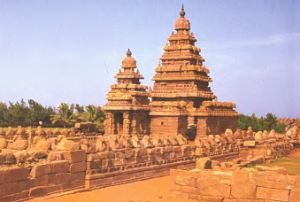
- Built during the reign of Pallava male monarch Narasimhavarman Two, likewise known as Rajasimha (700 – 728 Advertising).
- It has three shrines – 1 Shiva shrine facing east, one Shiva shrine facing due west, a middle shrine to Vishnu in Anantashayana pose. The presence of three main shrines is unique.
- It is probable that the shrines were not all built at the same time only were added later.
- There is testify of a water reservoir and a gopuram.
- There are sculptures of Nandi the balderdash (Shiva's mountain) along the walls of the temple. There are several carvings as well.
Dravidian Temple Compages – Brihadiswara Temple – Tanjore
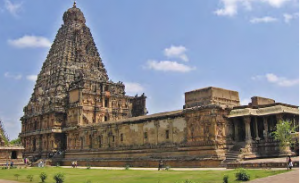
- Shiva temple, also called Rajarajeswara Temple.
- Completed effectually 1009 AD. Built by Rajaraja Chola.
- It is the largest and tallest of all Indian temples. This Chola temple is bigger than whatsoever of the previous Pallava, Chalukya or Pandya structures.
- More than 100 temples of the Chola Period are preserved. A lot of temples were constructed during the Chola period.
- Its pyramidal multi-storied vimana is almost 70 metres loftier.
- In that location is a monolithic shikhara atop the vimana.
- The shikhara is a dome-shaped octagonal stupika. It has two large elaborately sculptured gopuras. On the shikhara, there are big Nandi images.
- The kalasha on top of the shikhara is 3m and 8cm tall.
- There are hundreds of stucco figures on the vimana. Many might take been added subsequently on in the Maratha period.
- The main deity of Shiva is portrayed as a huge lingam set in a double-storied sanctum.
- The surrounding walls of the sanctum are adorned with painted murals and sculptures of mythological stories.
Architecture in the Deccan
- A hybridised style mixing elements from both Nagara and Dravida styles sally every bit a distinct style during the centre of the 7th century in regions similar Karnataka.
- This is referred to every bit Vesara in some ancient texts.
- Some of the temples are either completely nagara or dravida. Not all temples in the Deccan are in vesara style.
- Kailashnath Temple, Ellora
-
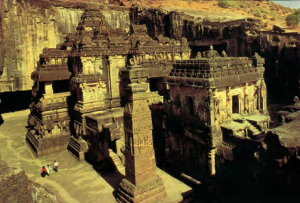
- Completely in Dravida manner.
- Main deity is Lord Shiva.
- There is besides a Nandi shrine.
- Vimana rises 30 chiliad.
- This temple was carved out of a portion of a loma.
- The temple is 1000 and imposing.
- Built during the Rashtrakuta phase at Ellora.
Chalukya Architecture
Hoysalas Temple Architecture
- Hoysalas grew into prominence in South India after the Chola and the Pandya power declined.
- Centred at Mysore.
- Chief temples are at Belur, Somnathapuram and Halebid.
- These temples have a plan called the stellate programme. This is because the program which emerged from being a straightforward square to a complex i with many projecting angles began to resemble a star.
- The star-like footing plan is a distinct feature of Hoysala compages.
- Fashion is Vesara.
- Made of soapstone which is relatively soft. This enabled artists to carve intricate details like jewellery.
- Hoysaleshvara Temple, Halebid
-
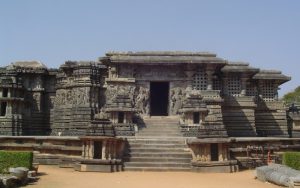
- Made of dark schist stone in 1150.
- Defended to Nataraja (Shiva).
- Information technology is a double building with a large hall for the mandapa.
- A Nandi pavilion is in front of each edifice.
- The temple's belfry barbarous a long time dorsum. The structure of the temple is evident from the detailed miniature ones at the temple'due south entrance.
- Very intricate and detailed carvings.
Vijayanagara Architecture
- Metropolis of Vijayanagara (City of victory) founded in 1336.
- Visited by international travellers similar Niccolo di Conti, Domingo Paes, Duarte Barbosa, Abd, al-Razzaq, etc. who have given vivid accounts of the place.
- Synthesizes the Dravida manner with Islamic styles of the neighbouring sultanates.
- The sculpture tries to recreate the Chola tradition but the foreign influence is also seen.
Temple Architecture in India-Part Three (UPSC Notes):- Download PDF Here
This affiliate is connected in the link given below:
NCERT Notes: Temple Architecture and Sculpture – Office IV
Too see other NCERT notes:
UPSC Books List PDF:- Download PDF Here
UPSC Preparation:
Source: https://byjus.com/free-ias-prep/ncert-notes-temple-architecture-and-sculpture-part3/
0 Response to "The Indian Art a Vimana Is a Cylindtical Towrr"
Post a Comment